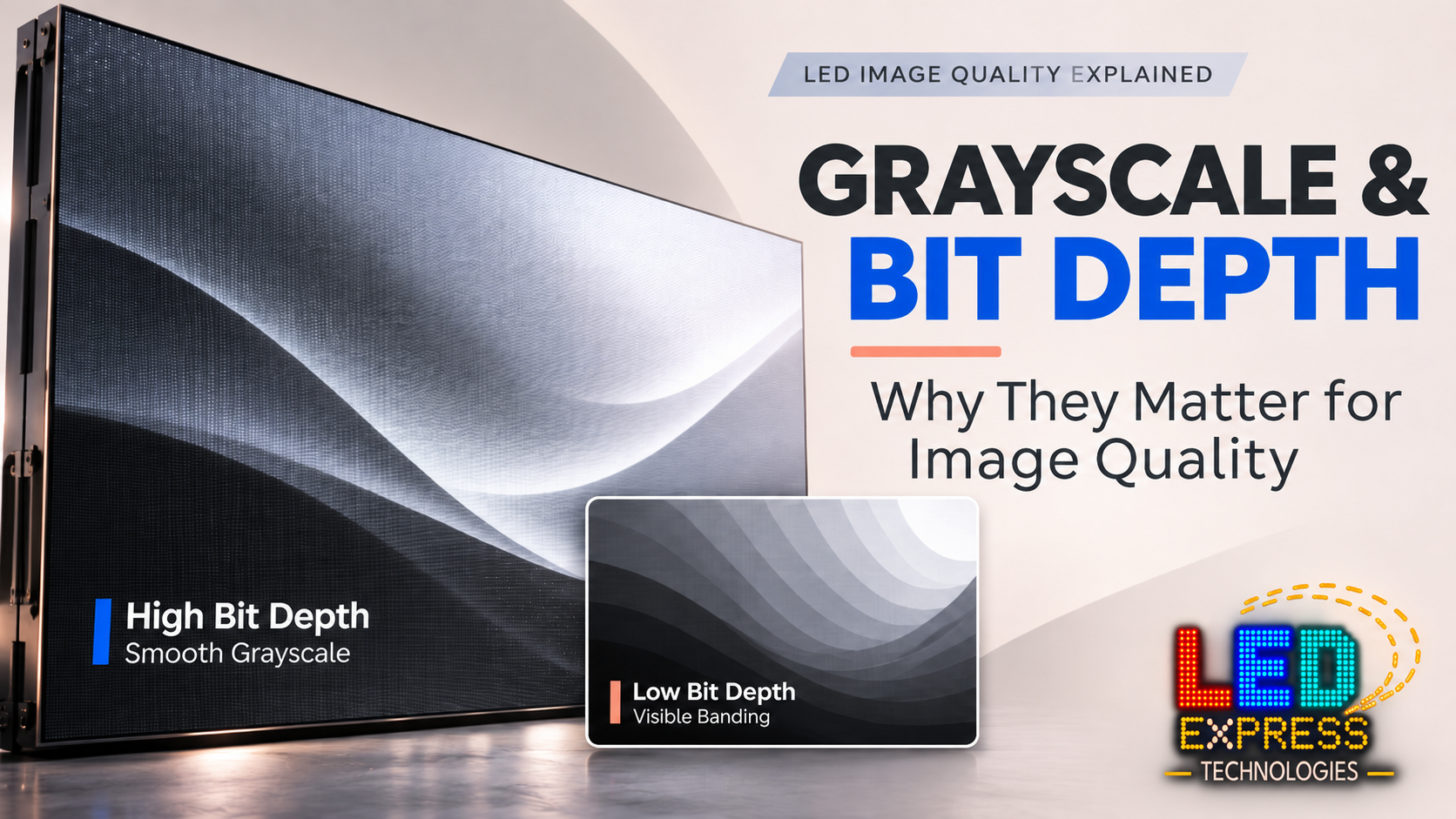
 At LED Express Technologies, we understand that choosing a high-quality LED screen involves more than checking its size, brightness or pixel pitch. Two important specifications that influence image quality are grayscale and bit depth. These features affect how smoothly an LED screen displays colours, shadows and brightness transitions. Therefore, understanding them can help businesses, churches and event organisers choose LED displays that deliver clearer and more natural images. Although buyers often focus on screen resolution, grayscale and bit depth in LED screens can make a significant difference in the overall viewing experience.
What Is Grayscale in LED Screens?
Grayscale refers to the number of brightness levels an LED display can produce between its darkest and brightest output.
In simple terms, it determines how gradually a screen can change from one brightness level to another.
Most full-colour LED screens use red, green and blue (RGB) light-emitting elements to create images. By controlling the brightness of each colour channel, the display produces different colours and shades.
For example, imagine an image showing a sunset. The sky contains gradual changes from bright orange to darker blue.
A screen with good grayscale performance can reproduce these transitions smoothly. In contrast, a screen with limited grayscale performance may show visible bands or abrupt colour changes.
This problem is commonly called colour banding.
As a result, grayscale plays an important role in displaying photographs, videos, graphics and other detailed content.
What Is Bit Depth in LED Screens?
Bit depth describes how many digital values are available to represent brightness or colour information.
Grayscale and bit depth in LED screens commonly refers to the number of brightness levels available for each RGB colour channel.
Generally, a higher supported bit depth allows finer brightness adjustments.
For example:
| Grayscale Bit Depth |
Brightness Levels per Colour Channel |
| 8-bit |
256 |
| 10-bit |
1,024 |
| 12-bit |
4,096 |
| 14-bit |
16,384 |
| 16-bit |
65,536 |
A 16-bit grayscale system can theoretically represent 65,536 brightness levels per colour channel.
However, the actual image quality depends on the LED driver ICs, control equipment, calibration, operating brightness and overall screen design.
It is also important to distinguish between the bit depth of the incoming video signal and the grayscale capability of the LED display. They describe different stages of image processing.
Therefore, a screen advertised as having 16-bit grayscale does not necessarily accept or display native 16-bit video content.
Why Do Grayscale and Bit Depth Matter?
1. Smoother Colour Transitions
One major advantage of higher grayscale precision is smoother colour transitions.
Consider a video showing a clear blue sky or a gradual change in studio lighting.
These scenes contain many subtle brightness variations.
If the display cannot reproduce enough intermediate levels, viewers may notice visible lines or bands between shades.
With suitable grayscale processing, these transitions can appear more natural.
This is particularly important for LED video walls used in premium event venues, churches, broadcast studios and corporate presentations.
2. Better Detail in Dark Images
Dark scenes can be challenging for LED screens.
For example, a video may contain a person standing against a dim background or objects appearing in shadow.
A poorly configured display may lose subtle details, making dark areas appear almost completely black.
Good low-grayscale performance helps the screen distinguish small brightness differences within these darker regions.
Furthermore, appropriate calibration can reduce unwanted colour changes and uneven brightness.
This makes grayscale performance particularly important for indoor LED video walls that operate at reduced brightness.
3. More Natural Colour Reproduction
Grayscale precision also supports accurate colour reproduction.
Each pixel combines different amounts of red, green and blue light to produce the desired colour.
When the display can control these colour channels precisely, it has a better foundation for reproducing subtle shades.
For instance, corporate presentations may contain brand colours, product photographs and carefully designed graphics.
A well-calibrated LED screen can help these visuals appear more consistent.
However, grayscale alone does not guarantee accurate colours. Colour calibration, gamma settings, LED characteristics and the video processor also affect the final result.
4. Improved Image Quality at Lower Brightness
LED screens do not always operate at maximum brightness.
Indoor installations, television studios and conference halls often require reduced brightness for comfortable viewing or camera recording.
Unfortunately, reducing screen brightness can make it harder for some LED systems to reproduce subtle grayscale differences.
This may cause visible banding, loss of shadow detail or uneven colours.
Advanced processing and calibration can help preserve image quality under these conditions.
Therefore, buyers should ask suppliers how an LED display performs at the brightness level they intend to use.
Grayscale vs Refresh Rate: What Is the Difference?
Grayscale and refresh rate both influence LED screen performance, but they serve different purposes. It determines how precisely the display can control brightness levels.
Refresh rate describes how frequently the LED display updates its output, usually measured in hertz (Hz).
For example, high refresh rates can help reduce visible scanning artefacts during video recording.
Meanwhile, good grayscale performance supports smoother brightness transitions and more detailed images.
Both specifications matter, especially for live events, churches, professional video production and television studios.
However, increasing one specification does not automatically improve the other.
The display’s driver ICs and control architecture may also influence the balance between grayscale performance and refresh rate.
Does Higher Bit Depth Always Mean Better Picture Quality?
Not necessarily.
Although higher grayscale capability can provide more precise brightness control, it is only one part of display quality.
A screen with an impressive bit-depth specification may still produce disappointing images if its components or settings are poor.
Other important factors include:
- Pixel pitch: Influences image detail at different viewing distances.
- Brightness: Determines how effectively the display performs under surrounding lighting conditions.
- Contrast: Affects the distinction between dark and bright areas.
- Refresh rate: Influences display stability and camera compatibility.
- Colour calibration: Helps maintain consistent colour reproduction.
- Video processing: Influences scaling, signal handling and image adjustments.
- LED module quality: Contributes to brightness uniformity and long-term performance.
Therefore, buyers should consider the complete LED display system instead of relying on one specification.
Which LED Screens Need Better Grayscale Performance?
Different applications have different image-quality requirements.
Churches and Worship Centres
Churches often display live video feeds, worship lyrics, photographs and presentation graphics.
Good grayscale and bit depth in LED screens helps reproduce facial details, stage lighting and gradual colour changes more naturally.
This becomes particularly important in auditoriums where LED video walls serve as primary visual displays.
Television Studios and Broadcasting
Broadcast environments require careful image control because cameras can reveal display imperfections that may not be obvious to the human eye.
Good low-brightness performance, suitable refresh rates and precise calibration are important for these installations.
Corporate Conference Rooms
Businesses use LED video walls for presentations, advertisements, product launches and video conferencing.
Smooth gradients and consistent colours can improve the appearance of corporate materials and branded content.
Event Centres and Entertainment Venues
Concerts, weddings and entertainment events frequently use LED screens to display dynamic visuals.
Good grayscale performance supports detailed backgrounds, lighting effects and video content.
Outdoor Advertising Billboards
Outdoor LED billboards must remain visible in bright environmental conditions.
Although brightness and weather protection are major considerations, grayscale performance also contributes to smooth image transitions and attractive advertising content.
What Should Buyers Check Before Purchasing an LED Screen?
Before choosing an LED screen, request a detailed specification from the supplier.
Ask about the supported grayscale level, refresh rate, LED driver ICs, receiving cards and video processing equipment.
In addition, request a demonstration using actual photographs and video content.
Pay particular attention to dark scenes, gradual colour changes and skin tones.
For indoor displays, ask to see the screen operating at a reduced brightness level rather than only at maximum brightness.
You should also ask whether colour calibration and appropriate grayscale optimisation are included in the installation process.
These checks can help identify potential display-quality problems before purchase.
How LED Express Can Help You Choose the Right LED Screen
Choosing an LED display involves balancing image quality, technical performance and project requirements.
At LED Express, we help customers understand important LED screen specifications so they can make more informed decisions.
Whether you are planning a church video wall, corporate display, event installation or digital advertising billboard, choosing suitable display technology matters.
Factors such as viewing distance, brightness, grayscale performance and control equipment should all be considered during product selection.
Rather than focusing only on the advertised specifications, buyers should evaluate how the complete screen performs in its intended environment.
Conclusion
Grayscale and bit depth in LED screens are important factors in determining LED screen image quality.
They influence brightness precision, smooth colour transitions and the visibility of subtle details in images and videos.
Although higher Ggayscale and bit depth in LED screens can improve visual performance, the final result also depends on proper processing, calibration and component quality.
Understanding these features can help businesses select LED screens that meet their viewing requirements and provide better long-term value.
Looking for a High-Quality LED Screen?
Planning to install an LED video wall for your church, business, conference hall, event centre or advertising project?
Contact LED Express Technologies for guidance on LED screen specifications, product selection, installation planning and technical support.
Choose an LED display that delivers the image quality your project requires.