
HDR on LED Screens: What It Means and When You Need It
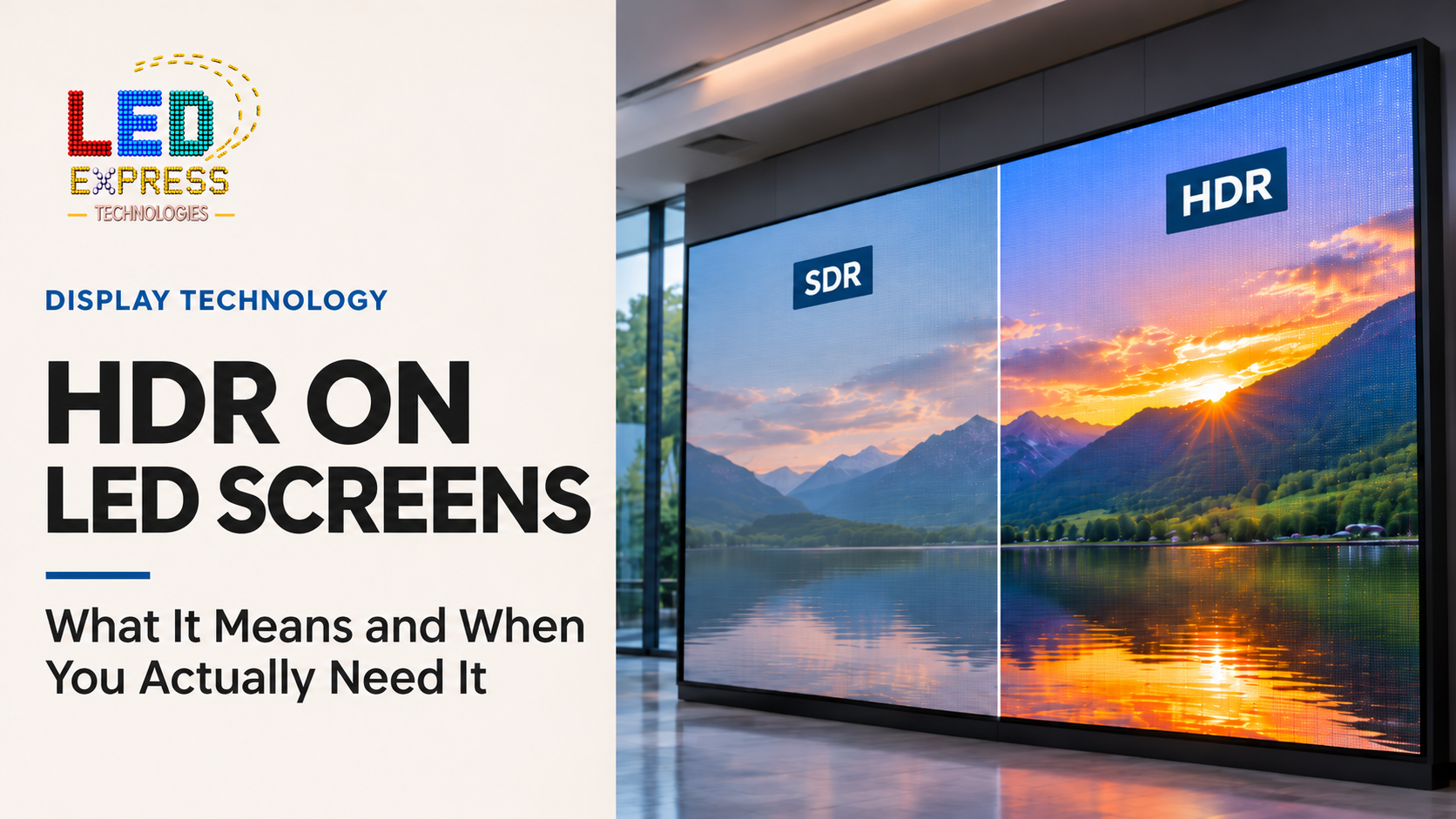
HDR on LED screens is becoming an important feature in modern display technology. At LED Express Technologies, we help customers understand how advanced display specifications affect picture quality and performance. Although many LED screens advertise HDR capabilities, not every installation requires this technology. Understanding its benefits can help buyers make better purchasing decisions.
What Is HDR on LED Screens?
HDR stands for High Dynamic Range. It is a display technology designed to reproduce a wider range of brightness and colour information than conventional Standard Dynamic Range (SDR) systems.
In practical terms, HDR can make bright areas appear more detailed while preserving information in darker parts of an image.
For example, a video showing sunlight entering a dark room contains both bright highlights and deep shadows. A properly configured HDR display can reproduce these differences more naturally.
However, HDR performance depends on the complete display system.
How Does HDR Improve LED Screen Image Quality?
Better Contrast and Shadow Details
HDR helps preserve differences between bright and dark areas.
This improves the appearance of videos containing complex lighting, shadows and highlights.
However, effective contrast also depends on the LED panel’s physical capabilities and calibration.
Richer and More Natural Colours
HDR systems often support wider colour gamuts and higher precision video signals.
Consequently, compatible displays can reproduce more subtle colour variations.
This is particularly useful for advertising visuals, professional video production and premium presentations.
Improved Brightness Control
HDR allows compatible systems to interpret brightness information from specially mastered content.
However, higher maximum brightness alone does not guarantee better HDR performance.
Proper tone mapping and calibration are necessary to match the content to the display’s actual capabilities.
HDR10 vs HLG: What Is the Difference?
Two common HDR formats are HDR10 and Hybrid Log Gamma (HLG).
HDR10 uses the Perceptual Quantizer transfer function and is widely used for mastered HDR video content.
HLG is designed particularly for broadcast and live production workflows.
Some professional LED controllers support both formats. However, the source equipment, processor and LED panels must be compatible.
When Do You Actually Need HDR?
HDR on LED screens is especially useful for:
- Television studios and professional broadcasting.
- Premium corporate presentations and product launches.
- Film production and virtual production environments.
- High-end indoor LED video walls.
- Concerts displaying professionally produced HDR content.
However, churches displaying mainly lyrics, schools presenting educational materials and businesses showing ordinary advertisements may achieve excellent results using properly calibrated SDR displays.
What Should You Check Before Buying?
Before purchasing an HDR LED display, consider:
- Supported HDR formats and input signal compatibility.
- Video processor and receiving card capabilities.
- Display contrast, brightness and colour performance.
- Calibration and tone-mapping features.
- Whether your content is actually produced in HDR.
Do not pay extra for an HDR label without confirming its practical benefits.
Conclusion
HDR on LED screens can improve contrast, colour reproduction and overall viewing quality when implemented correctly.
However, HDR is not essential for every application. The best choice depends on your content, environment and budget.
Contact LED Express Technologies Nigeria for guidance on selecting LED screens with suitable image quality, processing capabilities and installation specifications.
